


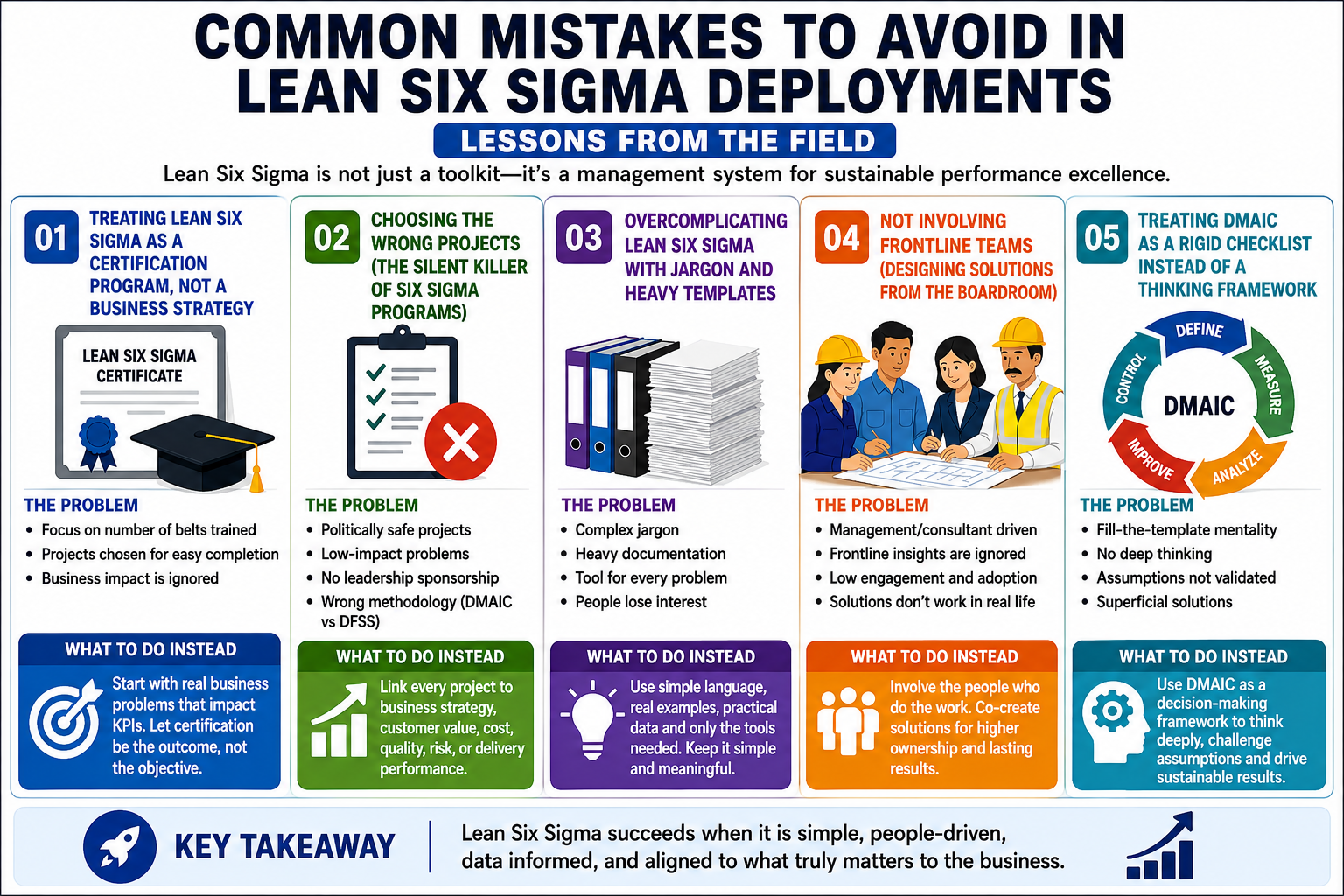

Mistake #6: Expecting Tools to Fix Culture
Lean Six Sigma tools do not change culture.
Leadership behavior changes culture.
Many leaders expect:
- A few belts
- Some dashboards
- A few projects
…to magically change mindsets.
But culture shifts only when leaders:
- Ask data-driven questions
- Encourage root-cause thinking
- Reward problem-solving
- Support experimentation
- Accept learning from failure
What to do instead:
Leaders must role-model Lean Six Sigma thinking.
When leaders ask:
“What does the data say?”
“What is the root cause?”
“What is the process failure, not the people failure?” …culture begins to change.
Mistake #7: Focusing Only on Cost Savings and Ignoring Customer Value
Lean Six Sigma is often misunderstood as a cost-cutting tool.
When employees hear:
“Six Sigma is here to reduce cost”
They translate it to:
“Six Sigma is here to reduce people.”
This creates fear, resistance, and hidden sabotage.
What to do instead:
Lean Six Sigma is about:
- Improving customer experience
- Reducing frustration
- Making work easier
- Reducing firefighting
- Creating capacity through waste elimination
Cost reduction becomes a result, not the purpose.
Mistake #8: No Governance, No Sustainability
Many deployments start strong but fade because:
- No review cadence
- No leadership governance
- No benefit tracking
- No standardization
- No capability building
Projects close, but benefits don’t sustain.
What to do instead:
Create:
- Monthly project reviews
- Benefit tracking dashboards
- Process ownership
- Control plans
- Knowledge repositories
- Internal coaches
Sustainability is designed — not hoped for.
Mistake #9: Ignoring Change Management
Lean Six Sigma changes:
- How decisions are made
- How problems are discussed
- How performance is reviewed
This is change, and change creates resistance.
Ignoring human psychology leads to:
- Passive resistance
- Compliance without commitment
- Silent failure
What to do instead:
Combine Lean Six Sigma with:
- Communication
- Leadership sponsorship
- Recognition
- Early wins
- Employee storytelling
Change sticks when people feel respected, not instructed.
Mistake #10: Treating Lean Six Sigma as a One-Time Initiative
The final and biggest mistake:
“We ran a Six Sigma program last year.”
Lean Six Sigma is not an event.
It is an operating system for excellence.
When treated as a project or campaign, impact fades.
What to do instead:
Embed Lean Six Sigma into:
- Performance reviews
- Strategy execution
- Operational reviews
- Leadership routines
- Daily management
When Lean Six Sigma becomes how the organization thinks, it stops being “a program” — and starts becoming the way work gets done.
Why ICEQBS Deployments Avoid These Mistakes
At ICEQBS, I’ve consciously designed our training and consulting model to avoid these common traps:
- Business-first, certification-second
- Real projects, real impact
- Simple tools, practical application
- Leadership alignment
- Frontline involvement
- Sustainability built into design
Our belief is simple:
Lean Six Sigma should make work easier, outcomes stronger, and decisions smarter.
Final Reflection: Lean Six Sigma Is Simple — We Make It Complicated
Lean Six Sigma works across industries, cultures, and scales.
It has survived decades because it solves real business problems.
When it fails, it is not because of the methodology.
It fails because of how we deploy it.
If you avoid these common mistakes:
- Your projects will matter
- Your teams will engage
- Your leaders will trust the method
- Your results will sustain
Lean Six Sigma will stop being “another initiative”
and start becoming your organization’s competitive advantage.
Call to Action
If you’re planning to launch or reset your Lean Six Sigma deployment, do it right.
At ICEQBS, we help organizations design Lean Six Sigma as a business transformation system, not just a training program.
👉 Explore our Lean Six Sigma programs
👉 Work on real business projects
👉 Build a culture of data-driven excellence
ICEQBS – Where Lean Six Sigma Becomes Real Business Impact